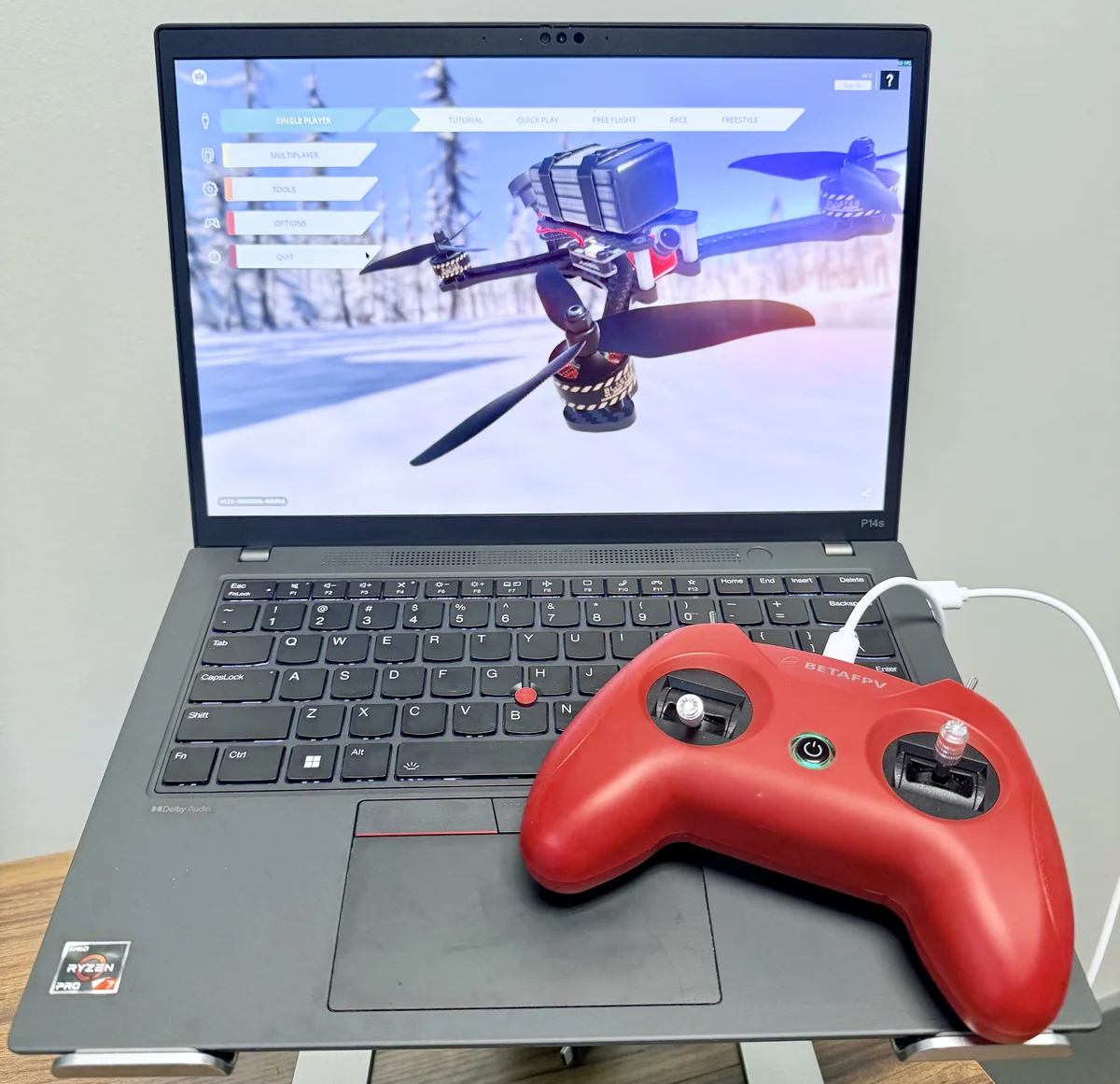
Flying in full manual mode — no sensors, no automatic leveling, no position or altitude hold, just raw stick inputs mapped to motor outputs — is the most direct way to understand how a quadrotor actually behaves. It takes dozens of hours of stick time and countless expensive crashes to get there.
Luckily there are plenty of drone simulators that can help. I picked Liftoff — it runs on Steam on Linux, easy to set up, and has everything I need. Twenty minutes in the evening, no weather dependency, no commute to a field, and the stick skills stay sharp.
The setup
My sim controller is a BetaFPV LiteRadio 2 — a dedicated sim stick that costs less than a single replacement motor on most builds. It connects over USB and runs Betaflight rates that match what I fly in the real world:
- Roll/Pitch: RC Rate 1.00, Rate 0.70, RC Expo 0.20 (667 deg/s max)
- Yaw: RC Rate 1.00, Rate 0.56, RC Expo 0.20 (455 deg/s max)
- Throttle curve: Mid 50, Expo 15, idle at 0.04
These might look like newbie-friendly rates to an expert flyer, but they work for me — my goal is comfortable acro flying, not freestyle tricks or racing. They match my real controller settings exactly.
What I actually practice
Always acro. No angle mode, no horizon — if the simulator is doing stabilization work for you, you’re not training.
My typical session looks like this:
Hover drills. Take off, hold position at eye level, 5–10 minutes. This sounds trivial. It isn’t. Holding a stable hover in acro with no GPS is a continuous feedback loop — small corrections on every axis, constantly. It’s the single most useful drill for building stick feel.
Orbits. Pick a point, fly circles around it while keeping the camera locked on target. This trains coordinated yaw and roll inputs, which is exactly what you need for inspection flying or keeping a subject in frame.
Figure 8s. Two orbits linked together with direction reversals. Forces you to manage momentum through transitions.
Races. Liftoff’s infinite race mode on several favorite tracks. Even if you know the gates position, size and distance, you can always train with a faster speed.
The sim-to-real gap
Here’s the thing about simulators: they’re clean. The physics model in Liftoff is good — it simulates prop wash, wind, battery sag — but it’s still an approximation. The turbulence is modeled, not measured. The wind is random, not the gust that funnels between two buildings at your flying spot. There’s no electromagnetic interference from a nearby power line making your gyro drift.
The simulator gives you the control theory. Reality gives you the noise. Whether you’re training a human pilot or a neural network, the lesson is the same: treat the simulator as a necessary first step, not a proof of readiness.